Are White South African Farmers Being Persecuted? An Insight into the “White Genocide” Claims and International Asylum.
By: Sarah Hirji, IST Tanzania
Increased Farmer Murders and Afrikaner Fear
On the 3rd of October 2020, two men were arrested in Fateng Tse Ntho, Paul Roux, South Africa. They were charged with the murder of the 21-year-old farmer Brendin Horner. Allegedly, these two suspects carried the bloodied clothes and shoes of the victim. Horner was claimed to have been confronting the two men as they were attempting to steal stock from his farm, resulting in brutal torture and murder. The young farmer was tied to a pole with a rope around his neck (Democratic Alliance).
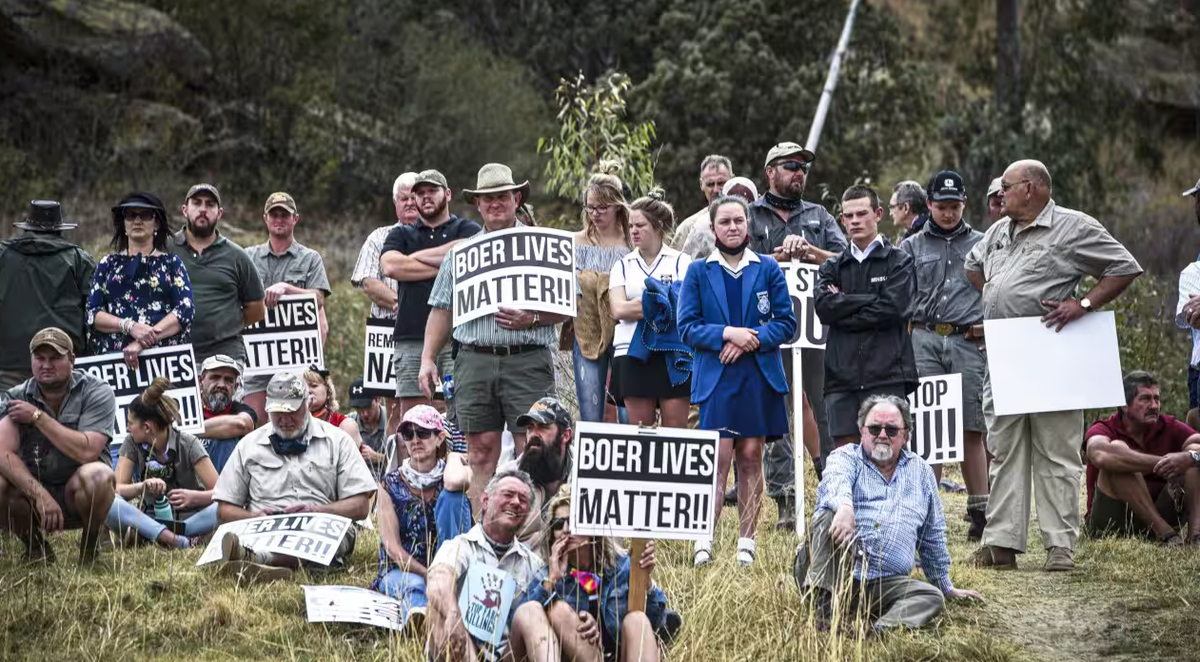
From the outside, farming itself does not seem like a dangerous task; you feed your livestock, water your crops, and apply fertilizers. What danger could there possibly be? However, in South Africa, the news of farmer murders circulates quickly, catching the attention of international audiences. In a BBC interview, an Afrikaner farmer, Marthinus, describes his anxiety.
"It feels like a prison," he shares, "If they want to come and kill us, they can. At least it will take them time to get to me." Marthinus shares this fear with many Afrikaners around his area, the Free State Province in South Africa. To give some context, Afrikaners are a group descended from Western European settlers who migrated to the southern tip of Africa in the mid-17th century (South African History Online). Marthinus lives only a two-hour drive from the murder place of the young farmer Brendin Horner, stimulating fear in his everyday life. "Our Afrikaner people are an endangered species," he claims (BBC).
While these violent crimes against white South African farmers are traumatic and pose a serious problem, framing these attacks as racial persecution reveals how fear, race, and political narratives shape whose suffering is recognized as persecution by global asylum systems.
South Africa ranks fifth among the most dangerous countries in the world. Crime is prevalent throughout the whole country, with a crime rate of 75.7 in 2025, considered to be very high (Statista). To give a global comparison, the United States has a crime rate of 49.2, and Tanzania with a 53.5 in the global crime index (World Population Review). Farm-specific attacks in South Africa (inclusive of all farmers) consist of stock theft, armed robbery, arson, and, in some cases, brutal murder. According to an article written by the University of Stellenbosch, all farmer communities have been affected by these high crime rates, including both white and black farmers. It has been recorded that white farmers own 75% of the land, meaning that it is inevitable that they will be exposed to crime, regardless of their race (Land Audit Report, SA Government 2017). The main reasons for crime against farmers include a culture of violence in South Africa, poverty and unemployment, and easy availability of weapons (Haefele). Many could argue that these attacks are not racially motivated, but farmer-motivated. The higher number of white farmers could be due to the large amount of agricultural land owned by white farmers.
Trump Signs an Executive Order: The United States Gets Involved
On the 7th of February, United States President Donald Trump publicly accused South Africa of “racial persecution.” The U.S government began to expedite refugee applications from Afrikaners. Accepting refugee applications from Afrikaners has come at a cost to other refugee admissions, which the Trump administration halted, including refugees from critical warzones. In addition, the South African government claims that there has been no existing persecution that would qualify for asylum, despite Trump's accusations of a “white genocide.” On the 13th of May 2025, BBC reports 59 white South Africans landing in the U.S. They arrived at Dulles Airport, where they received a warm welcome (BBC). This granted refugee applications from white South Africans has raised a crucial question: “To what extent does the ‘white farmer persecution’ merit asylum in the US?”
Orania: Separation as Security
As mentioned in Marthinus’s interview, some white South Africans believe that the Afrikaner group is an “endangered species.” After South Africa transitioned to a black-majority government, some Afrikaners argued for the creation of an Afrikaner-only town as a means of preserving cultural autonomy and security. Orania is a small town nestled in the Northern Cape, established in 1991, three years before South Africa’s first Democratic election. It was created for a “homeland” or a “volkstaat” in Afrikaans. Orania has its own flag, blue and white separated with a central emblem, a white figure rolling up his sleeves. All infrastructure and housing were built by Afrikaners; residents emphasize that all construction should be carried out exclusively by Afrikaners only (Webster).
There are many rules concerning racial divides in Orania, including the inability of black people to own or work in Orania’s land. Orania presents itself as not an act of protest, but as an act of protection. In an interview with Anadolu, a Turkish news network, Joost Strydon, the town’s spokesperson, reinforces this claim. “...South Africa has the right to preserve their culture and build out cultural self-determination, but someone has to uphold that right, and that's what we've done here. We've started the process of upholding our rights."
However, though Orania may seem like a safe haven for Afrikaners, some black South Africans criticize the existence of this town. Author and advocate Tembeka Ngcukaitobi discusses that Orania “represents downright hostility to the idea of a single, united, non-racial country.” (Webster). It raises many questions and criticisms about it being a repetition of Apartheid and segregation; however, 31 years after Apartheid, it is still allowed to exist.
Most Orania citizens reject Trump’s offer of asylum, although they agree with his recognition of Afrikaners being a minority. “We are glad we are recognized as a people, but we don’t want to be refugees in another man’s land,” Joost Strydom, Head of the Orania movement, says in an interview for Reuters. In a three-word response, “Help us here,” Strydom communicates that Afrikaners do not need asylum from the U.S, but instead need help for the investment and expansion of Orania.
Orania impacts the debate on international asylum because it deepens and complicates the claim that white Afrikaners, specifically farmers, face inescapable violence and persecution in South Africa. According to UNHCR, asylum law generally requires individuals to demonstrate the inability to seek refuge from persecution, and the absence of reasonable internal alternatives to relocation or protection. Orania has been explicitly designed to provide safety, cultural autonomy, and self-reliance, demonstrating that for some Afrikaners, this “insecurity” has been addressed through internal separation rather than fleeing the country. This does not negate the reality of violence or fear experienced by farmers elsewhere, nor does it invalidate individual asylum claims. This raises a critical question for asylum adjudicators: if the persecution against white Afrikaners was unavoidable, would internal responses such as Orania remain a valid option?
Why These Claims Gain So Much Attention Internationally
The visibility of the “persecution” of white South African farmers and their claims cannot be attributed to violence alone; it is formed by who is perceived as a “legible” victim, the importance of a farmer, and how political narratives travel. Firstly, South Africa is a country with an already high crime rate; farmer murders represent a tiny fraction of South Africa’s homicide total. The motive for these attacks is usually robbery rather than race-based persecution. Analysts argue that the label and claim of a “white genocode” misinterprets the scales and motives behind agricultural violence.
The nature of the occupation as a farmer contributes to the global attention. Farmers are seen as a figure that stands for self-reliance and rootedness, bringing sympathy. The attacks against farmers represent not only criminal acts, but as a threat to food production and a way of life, which makes them more emotionally and politically resonant beyond South Africa’s borders.
Media amplification has played a key role in developing farmer violence into a global narrative of racial persecution. Evidently, the Witkruis movement, which is essentially a memorial or a tribute to the white farmers who have been killed. White crosses are lined up along the grassy hillsides near a farm in Mokopane, South Africa. As reported by PBS, these crosses are seen as a necessary act of remembrance and honor, while several critics argue that it segregates the white farm murders from the epidemic of crimes inflicted on all South Africans across the country. The visual power of the movement, long, endless rows of identical white markers, each with the name, picture, and date of a killed farmer, has made this situation particularly resonant in international media, where it is often amplified without statistical content. In this way, local fear is being used to turn into international sympathy, resulting in widespread attention to this topic.
Conclusion
In conclusion, fear and persecution are highlighted by the debate over white South African farmers and their asylum highlights, and how global attention is captured by narrative and symbolism, as by harm itself. While these attacks against farmers do pose a real threat, responses such as Orania and the legal standards of asylum complicate claims about inescapable persecution. Overall, this case underscores that in international protection systems, some fears and claims are more readily accepted and believed than others, raising concerns and debatable questions on whose suffering is recognized as more important and why.