Built for Survival: Winning the Ice Age

By: Serafina Jaffer
International School of Tanganyika
Dar es Salaam, Tanzania
The Ice Age is known as one of the most challenging periods in human history, with freezing temperatures, a scarcity of resources, and harsh environments. Yet, despite these conditions, Homo sapiens not only survived but thrived. From inventing the needle to developing their communication skills, they proved to be the superior humanoid species. But the question remains: What made them so successful compared to stronger species such as the Neanderthals? Let’s explore what truly made them different.
Homo sapiens developed in Africa, which was one of the least affected regions by the cold of the Ice Age. The warmer environment gave them more time to evolve and provided stable conditions to live in. The variety of environments, such as forests and savannas, also helped Homo sapiens become highly adaptable.
While at the time, Homo sapiens didn't live directly in caves—unlike how they're sometimes portrayed in movies like The Croods—they did use natural features, such as in rock depressions and overhangs, as shelter. They would hang animal hides to block out cold winds, and with the fires blazing inside, these shelters provided effective protection from the harsh weather outside.
Unlike other species at that time, such as the Neanderthals, Homo sapiens developed fluent speech and the ability to organise and plan. This allowed them to share information and knowledge about their environment or discoveries. In addition, they also communicated through art and markings such as cave paintings. These cave paintings are important because they show how well Homo sapiens could express skills, ideas, beliefs, and values not just through speech, but through pictures too. Their ability to collaborate earlier made Homo sapiens stronger as a community.
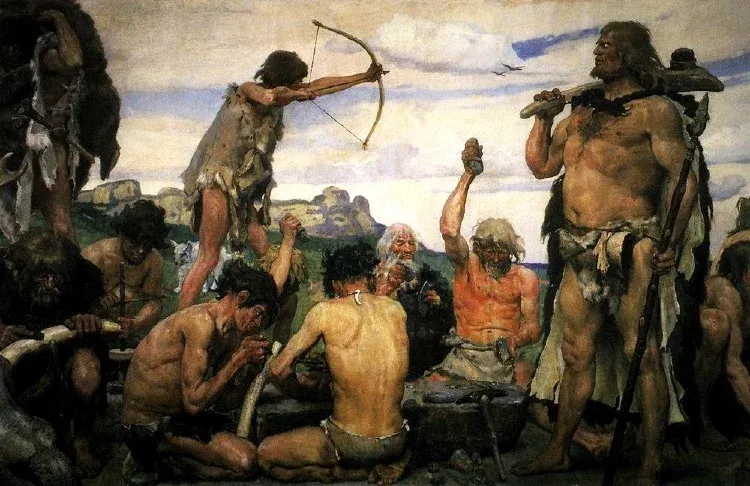
According to Professor Brian Fagan of anthropology, the most important invention in human history was the needle. The needle, dating back to 28,000 BC during the Ice Age, it not only allowed people at the time to sew clothing more efficiently, but it also spread quickly around the world. Homo sapiens used needles to stitch multiple layers of animal hides to create warmer and sturdier clothing to survive the cold. Different types of hides and skins served different purposes, contributing to their ability to withstand freezing temperatures. The needle wasn't the only crucial invention created in the Ice Age. Around 50,000 years ago, humans developed tools called geometric microliths, which were used as projectile weapons or knives. While other species were already competing for the limited resources the Ice Age had to offer, Homo sapiens had an advantage. Their tools, such as spearheads, hand axes, and harpoons, made them more effective hunters. Unlike the Neanderthals, who preferred to hunt more closely to their prey, using spears and short-range weapons, Homo sapiens created more projectile weapons, which allowed them to hunt from a further distance, which was a safer method compared to the Neanderthals’.