Lung Cancer: A Silent Global Crisis

By: Arnav Jasoria, IST Tanzania
What is cancer?
In 2022, nearly 9 million people died from cancer globally, but what is
cancer? ("Global Cancer"). Cancer is a disease in which abnormal cells multiply without control ("Overview of Cancer"). These abnormal cells are called mutations. These abnormal cells can spread to other parts of the body. The process of this spreading is called metastasis. If abnormal cells multiply over a long period of time, they can create huge lumps of cancer cells called masses or tumors. However, not all tumors are cancerous ("Overview of Cancer"). A tumor can either be benign or malignant. Benign tumors are noncancerous and are most likely to be removed through surgery. They are not life-threatening, and they don’t tend to come back after being removed. However, malignant tumors are considered cancerous and are a possible threat to life. Malignant tumors can spread to other tissues and organs nearby, making them harder to remove. Cancer can cause organs to not function properly. Cancer can also cause weight loss, fatigue, and much more ("Overview of Cancer").
What is lung cancer, and how is it caused?
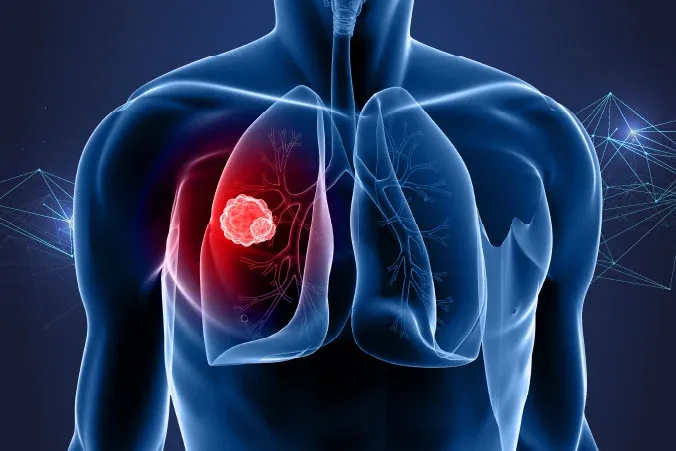
Similarly, lung cancer happens when cells in the lung mutate. This sudden mutation leads to the mutated cell growing uncontrollably and clustering together to form a mass/tumor ("Lung Cancer"). This cluster destroys non-mutated cells around the tumor. Lung cancer can be caused by many things. One is smoking tobacco or secondhand smoke. Every form of tobacco or secondhand smoke can lead to lung cancer ("Risks for lung"). The more you intake, the greater the chances. Radon is also another cause of lung cancer. It is an odourless, colourless, and tasteless gas which comes from the natural breakdown of uranium in rocks and soil. Radon can slip into buildings from cracks in the foundation or even dirt floors and can be very dangerous if in an unventilated area. In addition, asbestos is also a potential cause of lung cancer. Asbestos is a group of natural minerals that can be separated into long, thin fibres ("Risks for lung"). These fibres (if breathed in) can make their way to the very smallest airway of the lung. Other causes of lung cancer include: coming into contact with dangerous chemicals, air pollution, radiation, a weak immune system, physical inactivity, Arsenic in drinking water, and an unhealthy diet ("Risks for lung").
Did you know?
- Metastatic cancers are cancers that can spread to other parts of the body("Overview of Cancer").
- The process is called systematic spread, and there are two different ways. One way is through the blood system (arteries and veins) and the lymphatic system (vessels that drain and filter infectious agents throughout the body) ("Overview of Cancer").
- There are different types of lung cancers! One type is called Small Cell Lung Cancer (SCLC), and the other is called Non-Small Cell Lung Cancer (NSCLC).
- SCLC is not as common, whilst NSCLC makes up for 80% of lung cancer cases
- SCLC is much more dangerous since it spreads much quicker than NSCLC ("Types of Lung").
- There are different types of lung cancer tumors! One kind of tumor is called Pancoast, and the other one is called Carcinoid
- Pancoast tumors - found at the upper part of the lung. It interferes with structures around it and can be treated through chemotherapy, surgery, and radiation
- Carcinoid tumors - These tumors are rare and grow much more slowly compared to Pancoast tumors. They are made up of special cells called neuroendocrine cells and are mainly treated through surgery. ("Types of Lung").
Can we prevent lung cancer?
Now that we know what lung cancer is, let's see how we can prevent it. Lung cancer can be avoided in many ways. One of the most important things to avoid would be smoking and even secondhand smoke ("How Do You Prevent"). Research says that smoking increases your chance of getting lung cancer by 15 - 30 times. Additionally, around 15% of smokers develop lung cancer("What Percentage"). In 2014, 7,300 nonsmokers died in the US due to secondhand smoke (Naeem). Furthermore, plan on getting your house tested for radon("How Do You Prevent"). Radon accounts for 10-20% of lung cancer cases worldwide("Radon and lung"). Moreover, limit your exposure to harmful chemicals("How Do You Prevent"). Other things you must do to avoid lung cancer would be to eat a healthy diet
consisting of a lot of greens, constant checkups with the doctor("Lung
Cancer"). This is really important for people with a history of smoking
or exposure to harmful chemicals.
Effects of vaping and nicotine
The number of teenagers who vape is huge! The World Health Organisation stated that over 100 million people vape globally as of 2025, and out of that 100 million, 15 million vapers are between the ages of 13-15. Aren’t those numbers insane? But why is vaping so bad for your health? Vapes contain nicotine. Nicotine is found it all tobacco-based products like cigarettes and hookah(Barry). It is addictive and causes anxiety, depression while also worsening your memory, concentration, and self-control (Barry). Nicotine leads to issues with brain development, which occurs in your teenage years. This leads to sleep problems, exposure to cancer-causing chemicals, which may very well lead to lung cancer("Vaping: What"). In addition, brain damage from nicotine is permanent and can lead to behavioural issues as an adult, like constant mood swings. A research study in 2017 shows that those teenagers who smoke have higher carcinogenic levels in their urine compared to those teens who don’t vape(Martinelli). Showing that there is a correlation between vaping and cancer. Further research shows that 9 out of 10 adults who smoke cigarettes daily had their first cigarette by 18. This further proves that nicotine is addictive.
Why is nicotine so addictive?
Now that you have found out the effects of vaping. Let's dive deep into the science behind these effects. Once taken, nicotine travels from your bloodstream to the brain. It changes the chemical balance in your brain by binding with receptors all around the brain("Nicotine is addictive"). This binding causes the release of neurotransmitters, which are chemical messengers to your nerves, glands, and muscles. This release of neurotransmitters like dopamine can lead to the feeling of pleasure and reward. However, this feeling does not last long, which causes you to crave more nicotine, creating addiction("Nicotine is addictive"). After taking in nicotine over a period of time, your body creates a tolerance to it, and if you try to quit or stop taking nicotine for a while, it can create severe symptoms like intense craving for nicotine, anxiety, an increase in appetite, restlessness, and much more("Nicotine is addictive "). These symptoms are called nicotine withdrawal symptoms. That is why removing your addiction to nicotine and vaping is super hard. However, over time, these symptoms do go away if you stay away from nicotine("Nicotine is addictive").